
CLICK BELOW FOR AN AUDIO VERSION OF THIS BLOG
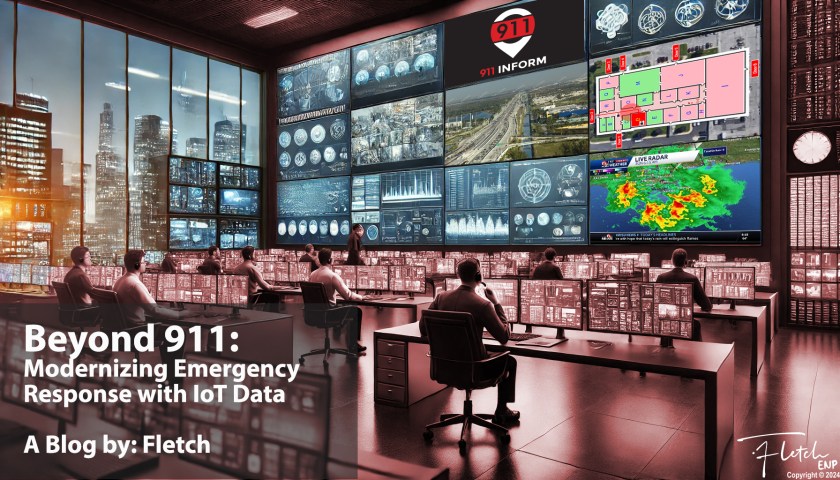
In today’s rapidly advancing technological landscape, ensuring the safety of employees and buildings has become much more sophisticated and effective through the integration of Internet of Things (IoT) sensors. These sensors provide additional real-time data that greatly enhances calls for service and emergency response efforts in general.
Still, 911 phone calls remain vital for initiating emergency responses over 240,000,000 times each year (as per NENA – The 911 Association), and the ability to dial 911 from any telephone is mandated by federal law. This crucial “trigger event” is how the public is trained to summon the need for immediate action. This trend will likely continue in the foreseeable future, primarily due to 97% of the country owning a cellular device and 85% of the country owning a smart device. At the same time, IoT devices have also continued to expand. Because of wired and wireless connectivity, these are becoming the first indicators of emergent events. Even when a phone call or other multimedia session initiates an alert, the correlating data from various IoT devices provides exceptional additional context. That information, which is often unknown or reported by the caller, can be essential in determining the appropriate levels of emergency response required.
For example:
- A 911 caller may report the smell of smoke in a building on the 10th floor;
- An IoT sensor may add the context of a high heat source on the 9th floor;
- Video cameras may show a stairwell fully engulfed in flames above the 8th floor.
Each element adds more context and information, leading to better situational awareness of the incident and a change in the response profile. With all three pieces of information delivered, dispatchers can ensure that sufficient resources are deployed and the correct type of resource is used for each situation. This approach enhances the overall response, making it more efficient and effective.
Below, we’ll explore various IoT sensor devices commonly available today, their function, and how they can be used to create a comprehensive safety net of information:
Types of IoT Sensors and Their Applications
- Temperature Sensors
- Function: Detects ambient temperature change.
- Use Case: Early fire detection by identifying unusual heat patterns. For example, if a fire starts in a server room, temperature sensors can detect the rising heat levels and trigger an alarm before the fire spreads.
- Gunshot Detection Sensors
- Function: Identifies the unique acoustic signatures of gunfire.
- Use Case: In an active shooter situation, these sensors can pinpoint the type of weapon used and the shooter’s location, assisting law enforcement in real-time response and containment.
- Gaseous and Chemical Detection Sensors
- Function: Monitors the air for harmful chemicals or gases.
- Use Case: In case of a chemical spill or a biological attack, these sensors can detect hazardous substances, enabling quick evacuation and decontamination procedures.
- Carbon Dioxide (CO2) Monitors
- Function: Measures CO2 levels to estimate human occupancy.
- Use Case: During a search and rescue operation, CO2 monitors can indicate the presence and number of people in a specific area, guiding rescuers to trapped individuals.
- Video / CCTV Cameras
- Function: Provides visual surveillance.
- Use Case: Modern cameras with 4K/8K resolution and capabilities like facial recognition and weapons detection can offer detailed footage that aids in identifying and tracking suspects in real time.
Enhancing Emergency Response through Integrated Data
The true power of these IoT sensors lies in their ability to communicate to a central core process. This server consolidates data from all of the sensor elements, allowing them to work together and creating a system where the sum of their data provides a more comprehensive picture of an emergency situation.
For instance:
- Fire Detection: Temperature sensors can alert to a potential fire, while video cameras can verify the presence of smoke or flames, allowing for a more immediate and more appropriate response.
- Active Shooter Scenarios: Gunshot detection sensors can identify the type and location of the gunfire, while CO2 monitors can estimate the number of individuals in danger. During the incident, video cameras may be able to identify the shooter, visually confirm location, as well as track the shooter’s movements.
Implementing an Effective Emergency Management System
With the ability to send NG911 data to NG911 network providers in North America today, and more PSAP ECCs coming online that can receive the information, for businesses to effectively make use of their IoT sensor data, a centralized platform that can integrate and analyze data from various sources is needed. This is where 911inform’s emergency event management solution comes into play. The system’s unique single-pane-of-glass architecture collects the IoT data and delivers a unified control panel dashboard for monitoring and managing the information during an event.
Initially developed to bridge the information gap between law enforcement and school resources during active shooter events, 911inform has expanded its capabilities to address the broader public safety challenges. The platform allows for seamless integration of new IoT technologies, ensuring that the overall emergency response system remains adaptable and up-to-date.
In a constantly evolving world, integrating IP-enabled IoT sensors into modern safety protocols is not only advantageous but essential. By leveraging a multi-layered approach and utilizing an intelligent centralized management solution from 911inform, organizations can enhance their emergency response capabilities, ensuring their employees’ and assets’ safety and security.
At 911inform, the focus is on simplifying the delivery of safety information through innovative new data presentation to the ECC and managing that data by the Enterprise. We are setting a brand-new standard for emergency response data by leveraging advanced technologies and a user-centric approach. As the industry evolves, the importance of actionable, productive data will only grow, underscoring the need for continuous innovation and improvement in this critical field.
IF YOU’RE AT APCO 2024 IN ORLANDO – Be sure to stop by booth 950 and meet 911inform’s dedicated Public Safety team Chief (Ret.) Ed Kirschenbaum and D.Sgt.(ret.) Adam Hubney for a fascinating demonstration of how 911inform can integrate into your agency workflow, and provide better situational awareness from connected buildings.
If you find my blogs informative, I invite you to follow me on X @Fletch911. You can also follow my profiles on LinkedIN and Facebook and catch up on all my blogs at https://Fletch.tv.
Thanks for spending time with me; I look forward to next time. Stay safe and take care.

Follow me on Twitter/X @Fletch911
See my profiles on LinkedIN and Facebook
Check out my Blogs on: Fletch.
© 2024, All Rights Reserved, Mark J. Fletcher, ENP
Reuse and quote permitted with attribution and URL
 The World According to Fletch . . .