
For an AUDIO COPY of this Blog LISTEN HERE
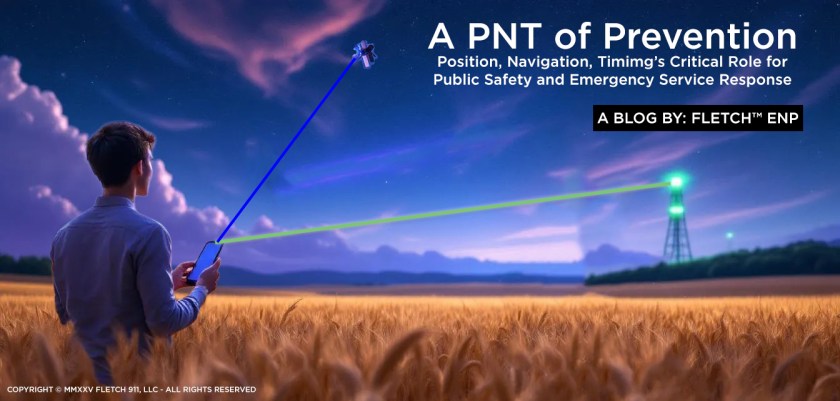
In the world of Emergency Services location technologies, PNT stands for Positioning, Navigation, and Timing—and it’s a whole hell of a lot more critical than you think, or it sounds:
- Positioning helps you pinpoint where you are on the planet.
- Navigation figures out the best route to get where you want to go.
- Timing ensures that everything syncs up with precise clocks.
Together, these are the Holy Grail of capabilities that power everything from Google Maps, to Waze, and even emergency dispatch systems.
🛰️ Two PNT Worlds: Satellite vs. Ground-Based
1. Satellite-Based GPS
GPS is the backbone of modern PNT. It uses satellites that broadcast timing signals that allow a device to calculate a precise 3D location (latitude, longitude, altitude) as well as the exact time. There’s no doubt about it, Space is cool. But Space also introduces some concerns and weaknesses with GPS PNT:
- Vulnerability: GPS satellites are in a stationary orbit that is 22,236 miles above the earth. The signals are very weak by the time they reach Earth, making them easy to jam or spoof—both unintentionally AND maliciously.
- Blind spots: In dense cities or indoors, GPS signals can be unreliable or nonexistent, again because they are weak.
- Single point of failure: No terrestrial backup exists. This means when GPS goes down, critical systems—first responders, telecom networks, financial systems—all suffer.
2. Ground-Based (Terrestrial) PNT
Then, there is the ground-based alternative: networks of ground transmitters using cell towers, beacons, or other licensed spectrum for Positioning, Navigation, and Timing—also called TCPNT or Terrestrial Complementary Positioning, Navigation and Timing.
Making these systems so powerful are things like:
- 🛰️ Resilience: Ground signals are stronger and not as easily overpowered by jamming and spoofing. Not perfect, but much better than GPS satellites.
- 🏢 Indoor coverage: The signals can penetrate buildings more easily—perfect for locating people inside high-rises .
- ⚙️ Scalable: The systems are built on the existing cell towers and 5G infrastructure; eliminating taxpayer money required to build new.
- 🛠️ Complementary backup: Works seamlessly with GPS for accurate location and timing, even should satellite signals fail.
Also, precise vertical and indoor positioning is already using these ground beacons and is reported as being live in thousands of cities.
⚖️ Why Public Safety Needs to Lead the Charge
The FCC is currently in the process of collecting responses to a Notice of Inquiry that intends to shape a Notice of Proposed Rulemaking. When released, it is anticipated to address the following public-safety priorities:
- Fast deployment—Roll out must be quick, not years down the road
- Use existing Terrestrial-based infrastructure
- Support for 3D positioning
- Deliver Nationwide scalability
- Integration into current public-safety gear
- Free for taxpayers, and independent of federal control
But in order to achieve this properly, it will need voices from the public-safety policy circles—similar to earlier efforts with FirstNet.
💼 Business-Savvy Analogies
- Imagine running a logistics company where GPS-backed tracking silently fails mid-route. Without a backup, packages transport is halted, customers frustrated, and trust lost. Now translate that to EMS or firefighting—but the stakes aren’t profit, they’re lives.
- Think of GPS as the primary power grid—essential, but vulnerable. A blackout can halt operations forever. Terrestrial PNT is like having solar arrays and backup batteries: reliable, distributed, and semi-autonomous—critical for emergency responders and essential services.
✅ Strategic Takeaways
- Public safety must submit comments to the FCC’s proceeding—all feedback is considered—from anyone.
- Align with associations like NENA, APCO, and others to amplify your voice.
- Engage your legislators to support funding and policy for resilient PNT infrastructure.
- Track private-sector providers that offer or use terrestrial PNT technology.
- Plan for readiness: Assess your ALL of your critical systems and ensure your technology will integrate PNT backups into your future investment plans.
🧭 The Bottom Line
PNT is critical infrastructure. Critical infrastructure demands Resiliency, Reliability, and Redundancy. A stand-alone Ground-based PNT solution or a stand-alone space-based system isn’t suitable in isolation, especially for critical Life Safety infrastructure.
RIGHT NOW, Public Safety agencies have a rare opportunity to define robust backup systems and solutions—and ensure lives aren’t left untracked should GPS fail.
As the industry evolves, the importance of actionable, productive data will only grow, underscoring the need for continuous innovation and improvement in this critical field.
If you find my blogs informative, I invite you to follow me on X @Fletch911. You can also follow my profiles on LinkedIN and Facebook and catch up on all my blogs at https://Fletch.tv. AND BE SURE TO CHECK OUT MY LATEST PROJECT TiPS: Today on Public Safety @ http://911TiPS.com
Thanks for spending time with me; I look forward to next time. Stay safe and take care.

Follow me on Twitter/X @Fletch911
See my profiles on LinkedIN and Facebook
Check out my Blogs on: Fletch and http://911TiPS.com
© 2025, All Rights Reserved, FLETCH 911, LLC
Reuse and quote permitted with attribution and URL
 The World According to Fletch . . .