

For an AUDIO VERSION of this Blog – See the Player Below:
We’ve all had that call. The one that sounds a little… off. Perfectly paced. No background noise. No breathing. The caller never reacts when you interrupt. If your “dispatcher Spidey sense” starts tingling, you might be dealing with one of two things:
- A nervous first-timer reading off a script,
- A bad actor playing a recording — or worse,
- An AI-generated voice — over the phone line.
In the era of NG911, swatting 2.0, and deepfake chaos, this isn’t just a nuisance; it’s a serious public safety problem. The good news? The technology to sniff this stuff out already exists. The bad news? Most of it isn’t in your PSAP yet. Let’s fix that.
⸻
Yes, We Can Tell
Scott Pisapia, a long-time Contact Center expert and colleague from Nortel and Avaya (who I initially trained on 911 some 20 years ago) reminded me that the very same tools that banks and call centers use to keep fraudsters out of their systems can keep PSAPs from being duped, as well. That prompted me to do some new research. Here’s what surfaced in the cI found in the IT toolbox today:
• Voice Biometrics & Liveness Detection
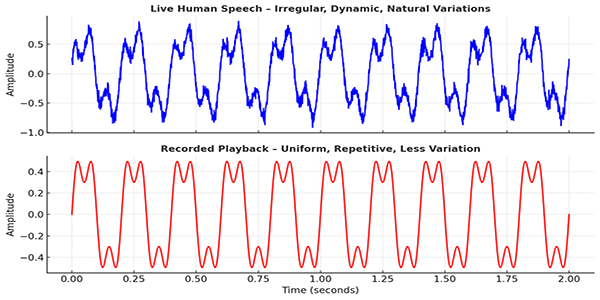
This examines the natural microvariations in breathing, tone, and timing that human speech produces, without thinking about it.. Recordings? Not so much.
Bonus trick: Give the caller a random phrase to repeat. A recording can’t do improv.
• Signal Analysis / Acoustic Fingerprinting
Computers can spot repeated patterns, unnatural silence gaps, and reverb artifacts that give away playback from a speaker or file.
• AI Speech Pattern Analysis
Machine learning can flag audio that’s too perfect or suspiciously uniform. Think of it as a “vibe check” for voices.
⸻
The PSAP Deployment Challenge
This is where the rubber meets the road. You can’t add tech that slows a call taker down — seconds count. Here’s how to integrate detection without turning it into an extra step:
1. Put It Inline
Run the analysis before the call taker even says hello. If your NG911 core or CPE can pass the audio stream through a detection engine the moment the call hits, you’ve already got a “real or fake” confidence score by the greeting.
2. Keep It Passive
Call takers get a small, non-intrusive visual cue:
- Green = Likely live
- Yellow = Suspicious
- Red = High confidence of playback or synthetic
It’s not an annoying flashing alarm, it’s just one more data point — like the ANI/ALI box — to guide your questioning and response.
3. Automate the Review
Flagged calls get tagged in the incident log for post-call deep analysis. Supervisors can review and refine the detection engine over time without bogging down live ops.
4. Train for the Cue
Dispatchers don’t change their opening. If they see Yellow or Red, they just slide in a quick liveness challenge:
- “What’s the nearest intersection to you right now?”
- “Can you tell me today’s date?”
If the caller can’t respond in real time, that’s a red flag on top of a red flag.
Then you use AI’s Achillies Heel. The desire to be incredibly accurate. Ask an obscure, but well-documented fact on the internet that the normal person would not know off the top of their head. For example, “What was the ocean depth where the Titanic sank?” This is a well-documented fact that AI would be salivating to show off its knowledge with.
GOTCHA!
⸻
Why This Matters
We’ve already seen AI-enhanced swatting incidents where the “caller” was a convincingly human-sounding voice that never once reacted to questions. The only thing that tipped it off was the uniformity in the audio. If that PSAP had liveness detection inline, they would have had a heads-up within seconds, potentially sparing officers from charging into a fake emergency.
This isn’t about delaying response — we always dispatch when there’s any doubt. It’s about giving call takers and supervisors another layer of intelligence to help them validate threats and protect resources.
⸻
Fletch’s Take
This is one of those “it’s not the future, it’s just not evenly distributed yet” moments. Banks have been using this for years. Call centers use it to weed out scam calls. But public safety — the sector that really can’t afford to be fooled — hasn’t widely adopted it. That’s backwards.
In my world, every NG911 system would have liveness detection baked right in:
- No extra clicks.
- No delays.
- Just a subtle early warning system for the people who need it most.
And if we do it right, one day a swatter will play their little pre-recorded “active shooter” file, and instead of panic on the console, the call taker will see a nice glowing red box that basically says:
“Nice try, buddy. We know you’re fake. Oh yeah. . . we also know where you are.”
Now that’s a feature worth funding federally.
If you find my blogs informative, I invite you to follow me on X @Fletch911. You can also follow my profiles on LinkedIN and Facebook and catch up on all my blogs at https://Fletch.tv. AND BE SURE TO CHECK OUT MY LATEST PROJECT TiPS: Today on Public Safety @ http://911TiPS.com
Thanks for spending time with me; I look forward to next time. Stay safe and take care.

Follow me on Twitter/X @Fletch911
See my profiles on LinkedIN and Facebook
Check out my Blogs on: Fletch and http://911TiPS.com
© 2025, All Rights Reserved, Fletch 911, LLC
Reuse and quote permitted with attribution and URL
 The World According to Fletch . . .