
For an AUDIO VERSION of the Blog – Please see the Player Below
We keep saying “call 911,” but here’s the kicker—most NG911 “calls” won’t even be phone calls. They’ll actually be data sessions, like video clips, or even IoT sensors tattling on your smoldering toaster. So why are we still ROUTING like it’s 1978? Maybe it’s time to flip the script.
Today we’ll be talking about how NG911 enables a fresh new workflow mindset, how anchoring emergencies at the network core (instead of constantly pushing data around to 911 calltakers) can make life easier, and why the phrase “911 call” may soon sound as outdated as “please be kind, rewind.”
NG911 – A Forklift, Not a Patch Job
Let’s be clear—NG911 isn’t just a software update. It’s a forklift replacement of the E911 architecture. We’re hauling out decades of duct-taped, analog infrastructure and rolling in a new IP-based, multimedia-capable backbone. Think about trading in your rusty Ford Pinto for a Tesla. Sure, both have four wheels, but only one can autopilot you past Wawa while streaming cat videos.
Legacy call handling equipment? Gone – No longer needed. We’re transitioning to VoIP-compliant platforms that support digital media. Caller location? Forget about a fuzzy street address like “near the Dunkin’ with the broken drive-thru speaker,” but precise geospatial coordinates. And the media? It’s not just voice—it’s now live video, images from the scene, sensor data, and even an individual’s wearable reporting their heart rate mid-panic attack.
Flipping the Script: Can We PLEASE Stop Thinking It’s All a Call
Here’s where things get weird. We keep calling it a “911 call,” but often there’s no phone involved. A smartwatch for fall detection? That’s not a call. A connected car screaming “airbags deployed”? Not a call either. A Ring doorbell live-streaming an intruder? Again—not a call. These are sessions—bundles of data tied to an event, and we need to start thinking that way, or we end up handcuffing our imagination.
By clinging to the “legacy call routing scenario,” we treat every emergency like a game of hot potato—tossing the entire data payload from PSAP to PSAP, dispatcher to dispatcher, unit to unit. Every handoff moves a significant amount of information, even if the responder only needs a small part of it. That’s like FedEx delivering a 50-pound box just so you can keep the packing slip.
The Data Buffet: Stop Force-Feeding the Information
In today’s E911 system, the initial call taker pulls in all the caller data. They add notes, add updates, then push the whole enchilada downstream to dispatch. Dispatchers forward it to a mobile unit, which initially only cares about two components: where do I go, and what’s going on? Yet the whole record—including the irrelevant extras—gets shoved along in one massive data dump. Alternatively, we can simply provide a list of available data elements, allowing responders to decide what they want and when.
It’s the all-you-can-eat buffet problem: everyone gets the entire spread whether they’re hungry or not. Inefficient, bloated, and begging for a more innovative approach.
Anchoring Sessions in the NG911 Core
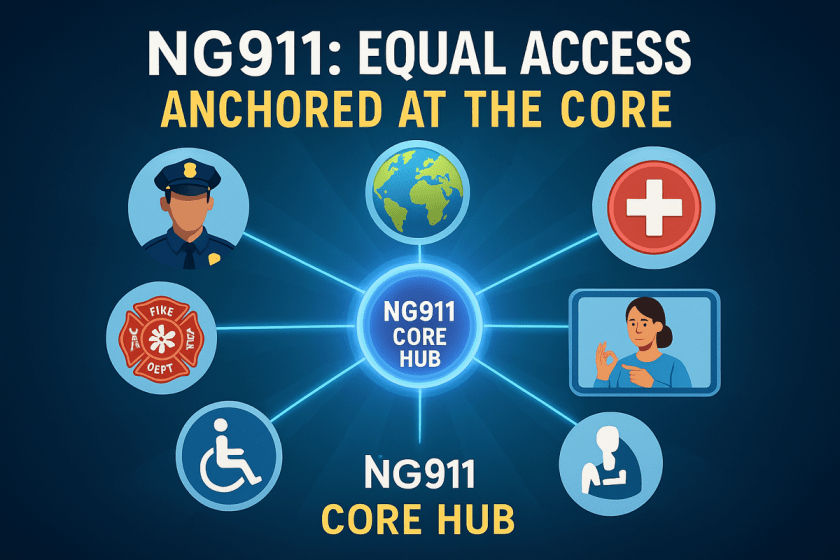
Here’s the NG911 fix: anchor the entire emergency session in the NG911 core. Instead of constantly pushing data around the network, we make the session data available as an anchored, single source of truth. Need to involve dispatch? Invite them to the session. Need the Fire department? Invite them too. Medical airlift? C’mon in and pull up a chair.
Each participant sees exactly what they need, when it’s needed—no more shoving terabytes through a straw. And as new players join the incident (like investigators or mutual aid agencies), they don’t need a backstory email chain. The full archive of data, media, and interactions is already waiting for them, neatly prepared and summarized in a standard consumable format.
But here’s where it gets really exciting: specialized services.
Anchoring sessions in the NG911 core means geography no longer dictates the quality of service. Let’s say the caller is deaf or hard of hearing and requires Video Relay Services. Instead of hoping the local PSAP of a 7,000-person town has a VRS-trained calltaker working, the NG911 core can instantly invite in a specialized video interpreter trained in ASL. The same applies to a person who is blind requiring advanced accessibility features, or someone who speaks Mandarin, Arabic, or a rare dialect of Swahili. Resources can join the session from anywhere through a standard INVITE.
The old model made these services a local PSAP problem. If they didn’t have the resources, the caller got second-best—or no service at all. In the anchored model, the core becomes the marketplace of specialized skills. No matter if you’re calling from Manhattan with 9 million neighbors or a cornfield town with one blinking traffic light, you can now get the same advanced services. That ensures equal access, every time, for everyone.
Language barriers shrink, too. Instead of frantic scrambling for “Does anyone here speak Pashto?” in a regional center, a language specialist from across the country can be dropped into the session instantly. This isn’t theory—it’s baked into how conference-style, pull-based sessions work. It was a concept that was design-intent when the NG911 architecture was first laid out 20 years ago. Specialized call takers with unique skills can live anywhere in the network and still join the emergency in real time.
Bottom line: anchoring at the core doesn’t just make us efficient. It makes us fair. It levels the playing field for people with disabilities, non-English speakers, or anyone needing specialized help. Geography stops being destiny.
Security and Policy Perks
This anchored model isn’t just efficient—it’s safer. Imagine a TDOS (telephony denial-of-service) attack. In today’s model, calls roll endlessly across PSAPs until everyone’s drowning. But in an anchored NG911 core, a single policy change at the regional hub cuts off the attacker, instantly protecting every node in the network.
It’s like blocking a scammer once on your phone and having that block magically apply to your spouse, kids, and grandma’s jitterbug. Nationally shared profiles? Instant. Threats contained? Done.
Rethinking Workflows
With NG911, we stop dragging emergencies to the call taker and start bringing resources to the anchored incident. That opens doors to resource sharing across jurisdictions, load balancing to avoid burnout, equitable service across geographies, and resilience against overloads. Instead of one PSAP crumbling under a flood of bad calls, the load is spread like butter across a warm bagel.
Bottom line: NG911 isn’t just new plumbing. It’s an opportunity to rethink how we approach emergencies altogether.
Summary
NG911 isn’t just “911 with better Wi-Fi.” It’s a re-architecture of how we handle emergencies, moving from a push-based, bloated process to a pull-based anchored model. It trims inefficiency, boosts resiliency, and—most importantly—levels the playing field. From big cities to small towns, from ASL users to rare dialect speakers, everyone gets the same advanced call-taking services. If we stop calling everything a “call” and start treating emergencies as anchored sessions, we’ll finally use the network as it was designed—smarter, faster, fairer, and more secure.
See my profiles on LinkedIn and Facebook and catch up on all my blogs at https://Fletch.tv.
AND BE SURE TO CHECK OUT MY LATEST PROJECT:
TiPS: Today in Public Safety @ http://911TiPS.com
Thanks for spending time with me; I look forward to next time. Stay safe and take care.

Follow me on X @Fletch911
Social Media: LinkedIN and Facebook
Blogs: Fletch TV™ and http://911TiPS.com
© 2025, All Rights Reserved, Fletch 911, LLC
Reuse and quote permitted with attribution and URL
 The World According to Fletch . . .